
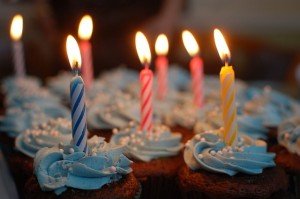
 The Dutch translation of “birthday” and “anniversary” is mostly the same: “verjaardag”. Sometimes “jubileum” is used as a translation for “anniversary”, see the examples in 1. and 2.
The Dutch have developed the strange habit of also congratulating family members and friends of the birthday boy/girl. We don’t know why 🙂 So do not be surprised if this happens to you. However, it seems this is changing a bit as an increasing number of people realize it is in fact strange and stop doing it.
The day on which you were born is “geboortedag”, but usually you will see “geboortedatum” (“date of birth”) when filling out forms etc.
1. birthday [noun] [de verjaardag, de verjaardagen] [‘ver-jaar-dag’]
Examples:
– “Vandaag viert koningin Beatrix haar zeventigste verjaardag.”
(“Today, Queen Beatrix celebrates her seventieth birthday.”)
– “Koninginnedag is niet de echte verjaardag van Beatrix…want zij is jarig op 31 januari…”
(“Queen’s Day is not Beatrix’ real birthday…because her birthday is on January 31st…” Beatrix honors her mother Juliana who had her birthday on April 30. Obviously the weather is also a lot better in April 🙂 )
Expression:
– “Abraham/Sara zien”: literally “to see Abraham/Sarah” this is said
when one reaches 50 – Abraham for the male and Sarah for the female.
You will see this on birthday cards or on decorated office doors.
Example:
– “Hij heeft Abraham gezien.”
(“He turned 50.”)
Related words:
– “Jarig“: No literal translation. “Jarig” is the adjective that indicates the state of one having one’s birthday.
– “Geboortedag”: day of birth, sometimes also “anniversary”.
– “Vieren“: to celebrate.
– “Feest“: party.
– “Viering”: celebration.
2. anniversary [noun] [de verjaardag, de verjaardagen] [‘ver-jaar-dag’]
Examples:
– “In 2003 vierde Cuba de vijftigste verjaardag van de Revolutie.”
(“In 2003 Cuba celebrated the Revolution’s fiftieth anniversary.”)
– “Vorig jaar heeft Lizy haar 25-jarige werkjubileum gevierd.”
(“Last year Lizy celebrated her 25th work anniversary.”)
Related word:
– “Jubileum”: jubilee, anniversary.
 – “Sander viert vandaag zijn 32e verjaardag. Hiep hiep
  “Afzakkertje” generally stands for one last drink. Translation depends on context, see 1. and 2.
 This phrase is used when things are difficult or almost impossible to accomplish or when a situation is tough in general. And this can be anything, from lousy weather to climbing the Mount Everest and from boring presentations to difficult exams. You can use it as part of a sentence but also on its own.
 Instead of “ontspannen” the Dutch often use “relaxed” and “cool” too. Mind that the English words – when used in Dutch – are declined according to the Dutch rules, see the last example.