
outlawed [adjective] [‘voo-gul-vrij’]
"Vogelvrij"
is composed of "vogel" ("bird") and "vrij" ("free"). Although it sounds
like being free as a bird, the real meaning of "vogelvrij" is that you
are not protected by law.
Today in the Netherlands this word is mainly used in its figurative
sense, most often in the expression "iemand vogelvrij verklaren": to
outlaw somebody.
Examples:
– "Velen vrezen dat Geert Wilders zichzelf vogelvrij verklaart als hij zijn film over de Koran uitbrengt."
("Many
fear that Geert Wilders outlaws himself if he releases his film about
the Koran." Here we refer to the Dutch politician Geert Wilders who plans
to release a critical film about the Koran titled ‘Fitna’. There are
already protests against this film (in the Netherlands but also abroad)
even though it has not been released yet.)
– "In het wilde Westen was het niet ongebruikelijk dat iemand vogelvrij werd verklaard."
("In the Wild West it was not uncommon for somebody to be outlawed.")
– "Er is onlangs een document gevonden uit de negentiende eeuw
waarin de onschuldige wetenschapper Giordano vogelvrij werd verklaard."
("A document from the nineteenth century has recently been found in which the innocent scientist Giordano was outlawed.")
Related words:
– "Rechteloos": lawless.
– "Straffeloos": unpunished.

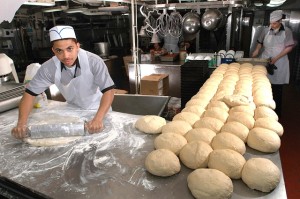 Besides the person who bakes bread, in Dutch “bakker” is also used to refer to the bakery (shop), see the Examples. Note that a “bakery” is a “bakkerij” in Dutch. The ending in “ij” is common and you will see it in other words like “makelaardij”, “schoenmakerij”, “slagerij” etc. (it is comparable to the Spanish “ía”).