Verreweg

by far, far and away, easily [adverb] Iconspeaker_klein_2

"Verreweg" is composed of "ver" ("far") and "weg" ("way/road"). The additional "re" in the middle is basically glue, but comes natural to the Dutch speaker. Mind that without the "re" it would sound as "ver weg" which means "far away".

Examples:
-"Pieter van den Hoogenband is verreweg de meest succesvolle Nederlandse zwemmer."
("Pieter van den Hoogenband is easily the most successful Dutch swimmer." Read more about Pieter in the Extra below.)

– "Bea is verreweg het aardigste meisje dat je in de trein van Den Haag naar Amsterdam kan ontmoeten."
("Bea is by far / far and away the nicest girl who one can meet on the train from The Hague to Amsterdam.")

– "Ik was vroeger goed in alle vakken op school, maar ik vond wiskunde verreweg het leukste vak."
("I used to be proficient in all subjects at school, but mathematics was by far my favourite subject.")

Extra:
Pieter_van_den_hoogenband_2
Other than being very successful, Pieter van den Hoogenband is also a very popular sportsman. In fact he has almost become a BN’er (Bekende Nederlander) by now. Pieter van den Hoogenband officially retired from professional swimming after the Beijing Olympics where he was not as successful as he and the entire Dutch population had hoped.
He was world record holder on the 100m freestyle for 8 years, a record set in Sydney 2000. In the past 6 months this record was broken 12 times, attributed to the recent advances in swimming attire of which the more force-driven swimmers seem to take most advantage. Pieter van den Hoogenband however was never renowned for his strength, but more for his technique.

Reason for Pieter’s popularity outside the swimming pool is his genuine friendlinMaarten_van_der_weijdeness and down to earth, modest, mentality. A typical Pieter van den Hoogenband performance in this context is his reaction to his friend Maarten van der Weijden winning the 10km open water race during Beijing 2008. Check out this video of the last meters of Maarten’s winning race (first wait for the commercial to end). You will hear Pieter – a commentator during the race – screaming euphorically and then after the race you will see him hugging Maarten. The fragment is taken from yesterday’s talkshow "Holland Sport". If you are bored and your Dutch is good enough you can keep watching the show which is all about Pieter van den Hoogenband and Maarten van der Weijden. Another interesting note is the fact that Maarten van der Weijden recovered from leukaemia in 2001 and managed to return to professional swimming.

Aan de slag!

(Let’s) get going / get to work! [Dutch phrase of the week] Iconspeaker_klein

Aan_de_slag_met
This phrase can be used to encourage people to start with an activity right away, or as an announcement that you (all) are going to get busy. The activity is usually involves serious effort such as studying or work.

You can also use the phrase with the verbs "zijn" and "gaan". You will use "aan de slag zijn" for being in a work related activity or "having a job" (informally). Alternatively you can use "aan de slag gaan" for going to start an activity or "starting a job" (informally). Check out the example sentences.

Note that you will mostly hear the word "slag" used in its translation of "blow/stroke/strike" or "battle".

Examples:
– "Jongens het is al half 9 geweest, open je boek op pagina 16 en aan de slag!"
("Guys, it’s past 8.30 now, open your book at page 16 and let’s get going!")

– "Ok mensen, de koffie is op, aan de slag!"
("Alright people, we have finished our coffee, let’s get to work!"

– "Na drie weken vakantie ga ik morgen weer aan de slag; jammer!"
("After three weeks of holiday, I’m getting back to work tomorrow; too bad!)

– "Zal ik jullie morgen komen helpen?" – "Nou graag, maar we gaan wel al om 8 uur aan de slag!"
("Shall I help you out tomorrow morning?" – "Well, please do, but mind that we will be starting at 8!")

– "Het was gezellig om weer bij te kletsen, maar nu is het tijd om weer aan de slag te gaan!"
("It was really nice to catch up again, but now it’s time to get back to work!")

– "Chantal zoekt al heel lang een baan. Ze ziet er echt naar uit om weer aan de slag te gaan."
("Chantal has been looking for a job for quite some time now. She is really looking forward to getting back to work.")

Medaille

medal, prize-medal [noun] [de medaille, de medailles] Iconspeaker_klein_2

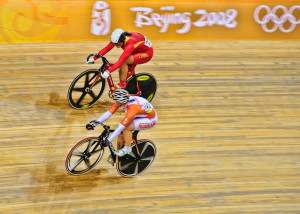
Baanfietsen, Olympische Spelen 2008The word “medaille” is the topic of conversation on Dutch sport news these days, and probably not only in the Netherlands 🙂 Even though a small country, the Dutch participate in many sports at the Olympics, ranging from sailing to fencing. Sometimes we see Dutch sportsmen/women competing who we have never heard of!
(Photo by Chris Coleman (flickr.com) – some rights reserved.)

The Dutch typically do well in hockey, swimming, rowing and judo where “we” expect some medals. We always have our hopes up for the Dutch volleyball teams, the cyclists and the gymnasts. So far the Netherlands is at the ninth place in the medal ranking (“medailleklassement”) with one gold (4x100m Freestyle Relay Women – last time was in 1936!), one silver (Judo Women -57 kg) and one bronze medal (Judo Men -60 kg).

These Olympics there is excitement for the Dutch gymnast Epke Zonderland, who is the first Dutch (male) gymnast to participate since 1928.

Although the word “medaille” is borrowed from French, the pronunciation will be Dutchified 🙂 However, the practical rule is to at least try to approach the French pronunciation. Some fail miserably at this and talk of a “mee-dal-ju” where the “dal” is emphasized more significantly.

A slang word for “medaille” is “plak” (“slice”), and you might hear a Dutch winner talk about his or her “gouden plak”.

Examples:
– “Nederland heeft tot nu toe drie medailles gewonnen.”
(“Up to now the Netherlands have won three medals.”)

– “Als topsporter doe ik alles voor een gouden medaille!”
(“Being a professional athlete/sportsman/sportswoman, I would do anything for a gold medal.” A “topsporter” literally translates to a “top sportsman”.)

– “Vertel ons eens, hoe voel je je, nu dat je geen medaille hebt behaald?”
(“Now that you have not won a medal, tell us, how do you feel?” The verb “behalen” can also be translated with “to obtain” or “to achieve”.)

– “Het winnen van een gouden medaille op de Olympische spelen was mijn droom. Nu is deze droom in duigen.”
(“Winning a gold medal at the Olympics was my dream. Now this dream is shattered. Note that “in duigen” is short for “in duigen gevallen”.)

Expression:
– “Elke medaille heeft een keerzijde”: every medal has two sides / its reverse.

Related words:
– Olympische spelen: Olympic games, Olympics.
– Medaillewinnaar: medallist [noun] [de winnaar, de winnaars]. Literally a “medal winner”.
– Medailleklassement: medal ranking [noun] [het klassement, de klassementen].
– Plak: slice. Slang for “medal” [noun] [de plak, de plakken].

Uitstellen

to postpone, to put off, to procrastinate [verb] [stelde uit, uitgesteld] [‘uit-stel-lun’] Iconspeaker_klein

Note that there is no direct translation of "to procrastinate" in 
Dutch. It will be either clear from context
that you are (once again
🙂 ) procrastinating, or if you want to be clear you can use
"voortdurend uitstellen" (to keep putting off).

Examples:Doe_het_vandaag_3
– "Heb je ook gemerkt dat Frank zijn werk uitstelt?"
("Have you also noticed that Frank puts off his work?")

– "Ik heb de neiging om lastige telefoontjes uit te stellen, jij ook?"
("I tend to put off tricky phone calls, you too?" Lit. "I have the
tendency to…" Note that a "telefoontje" is literally a small
telephone, but most common a popular word for a phone call.)

– "De wedstrijd tussen Ajax en Feyenoord is uitgesteld wegens slecht weer."
("Due to bad weather the match between Ajax and Feyenoord has been postponed.")

– "David is echt lui, hij stelt altijd alles continu uit!"
("David is really lazy, he is always procrastinating!" The word "continu" is a synonym for "voortdurend".)

Expressions:
– "Stel niet uit tot morgen wat je vandaag kan doen": never put off till tomorrow what you can do today.

"Van uitstel komt afstel": this expression is used as a warning; if you
keep putting something off, it will not happen anymore ("afstel").

Related words:
– Uitstel: postponement [noun] [het uitstel, no plural].
– Lui: lazy [adjective].

Uitschakelen

The verb "uitschakelen" can be used in different ways.

1. to switch off [verb] [schakelde uit, uitgeschakeld] [‘uit-schaa-ku-lun’] Iconspeaker_klein

Uitschakelen_windows
In this translation "uitschakelen" is most commonly used for engines, but you can use it for small devices too, such as phones. You will also hear "afzetten" and "uitdoen".

Examples:

"Als u lang moet wachten voor een open brug, schakel dan de motor uit."

("If you have to wait long in front of an open bridge, then turn of the engine.")

– "Dames en heren, wij zijn klaar voor vertrek. Wilt u alle elektronische apparatuur uitschakelen en opbergen?"
("Ladies and gentlemen, we are ready for departure. Would you please switch off all electronic devices and stow them?")

2. to eliminate, to rule out, to cut out, to knock out [verb] [schakelde uit, uitgeschakeld] [‘uit-schaa-ku-lun’] Iconspeaker_klein

Other common verbs to use are "verslaan" ("to beat (in a game)") and "verslagen worden" ("to be beaten").

Examples:
– "Toen Napoleon ook zijn laatste vijand had uitgeschakeld, stond niets hem meer in de weg."
("When Napoleon had also eliminated his last enemy, nothing stood in his way anymore.")

– "Het Nederlands elftal is door Rusland uitgeschakeld. Jammer maar helaas!"
("The
Dutch team has been knocked out by Russia. Too bad!" Literally, "jammer maar helaas" translates to "pity but alas".) 

3. to be out of circulation  [verb] [schakelde uit, uitgeschakeld] [‘uit-schaa-ku-lun’] Iconspeaker_klein

Ronaldo_uitgeschakeldA third meaning of "uitschakelen" is only used with the past participle, in case of being out of circulation through ill health or because of injuries.

Examples: 
– "Laura is twee dagen uitgeschakeld vanwege een blindedarmontsteking, en daarom schrijft Sander vandaag de DWOTD."
("Laura is out of circulation due to appendicitis, and that’s why Sander writes the DWOTD today.")


"De voetballer is drie maanden uitgeschakeld vanwege een enkelblessure."

("The football player is out of circulation for three months because of an ankle injury.")